Slate, and what separates one from another.
Slate is sold as though it were one thing. It is not. Where it was quarried, how thick it is and how it is fixed decide whether the roof lasts thirty years or a hundred, and on this coast the fixing matters as much as the stone.
No call-out charge, and the phone is answered 24 hours.
Written prices
the quote is the price, agreed before we start
Free quotes
no call-out charge, and a written price before anyone starts
24 hours
someone answers the phone, storm or shine
Fully insured
every job covered, from a single slate to a full re-roof
01/
Slate roofing.
Welsh slate is the benchmark, and the reason so many roofs round here were still watertight at ninety years old. It is dense, it splits thin, and it barely moves. It is also the dearest thing on the list, so it tends to go on houses where matching the original matters more than the invoice does.
Most new slate roofs in Cumbria are Spanish, and there is nothing wrong with that as long as you buy the right grade. The good ones are tested to T1 and S1 — the marks that say the slate will not rust-stain or delaminate — and they will see out fifty or sixty years. The cheap ones are the same colour and a different proposition entirely, and telling them apart on a pallet is most of the job.
Then there is the local stone. Westmorland and Burlington green is thicker, heavier and laid in diminishing courses, largest at the eaves and smallest at the ridge. It is a different trade from hanging a uniform slate, it needs a roof structure that can carry the weight, and it is what makes a Lakeland roof look like a Lakeland roof.
What we fit
- Welsh slate, where the roof is meant to outlast everybody
- Spanish slate in tested T1 and S1 grades, never the unmarked stuff
- Reclaimed slate, sorted and graded to match an existing terrace
- Westmorland and Burlington green in diminishing courses
- Copper or aluminium nails, never anything that will rust out
- Slate hooks where the exposure or the pitch calls for them
- Head laps set for the pitch and the exposure, not to a default
- Lead valleys, soakers and abutments in code-appropriate lead
Also called Natural slate · Welsh slate · Spanish slate · Lakeland green slate · Reclaimed slate
Want a price for this?
Describe what you can see from the ground and we'll tell you what it is likely to be. Coming out to look costs nothing.
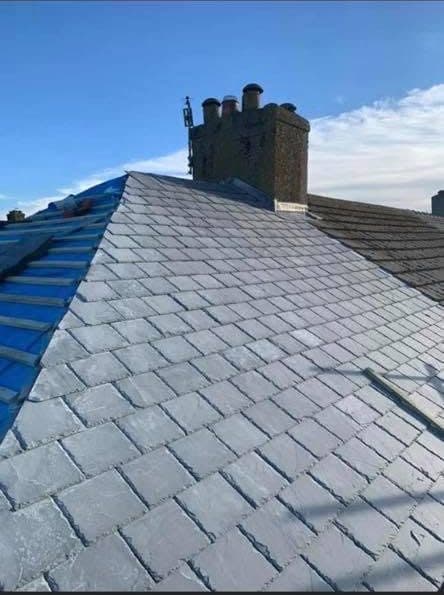
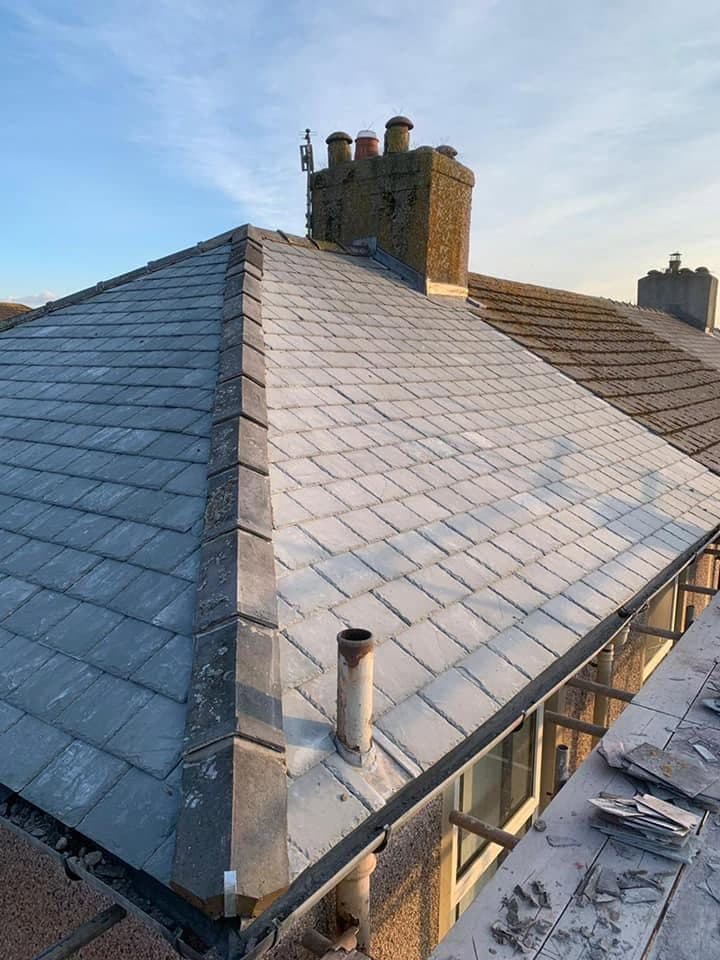
What the work looks like.
Our own photographs, taken on our own roofs — not a stock library.
02/
Worth knowing.
- Welsh or Spanish?
- Welsh if you are matching a good original roof or you want a hundred years. A tested Spanish slate if you want sixty and a sensible price. We will quote both.
- Nails or hooks
- Hooks are not a shortcut. On an exposed roof or a shallow pitch they hold better than nails and make a future repair far less destructive.
- Reclaimed slate
- Worth it to match a terrace. Every slate gets checked and sounded first — a reclaimed roof is only as good as the sorting that went into it.
- What the sea does
- Driven rain on this coast gets under a short head lap. We set laps for where your house actually stands, which is why an exposed roof costs a little more in slate.
03/
The rest of slating and tiling.
These sit alongside this one under slating and tiling. If yours turns out to be one of those instead, the price is worked out the same way.
New roof installation
The first roof on a new build, an extension, a dormer or a garage — worked out for the pitch and the exposure before a single slate goes on.
Re-roofing
Stripped to the rafters, felted, battened and re-covered. A standard semi is usually two days once the scaffold is up.
Heritage roofing
Listed buildings, conservation areas and old stone houses. Reclaimed slate, lime mortar, and the conversation with the conservation officer before the scaffold goes up.
Stone roofs
Cumbrian stone slate and Westmorland green, graded and set out in diminishing courses. Heavy coverings, so the timbers get looked at before anything goes back on.
The other things we do.
Most jobs turn out to be more than one of these at once. If you're not sure which you need, describe what you can see and we'll work it out.
Slating and tiling
Nearly every pitched roof on this coast is slate. Stripping them, re-covering them, matching them to the terrace next door and putting stone back on the ones that had it.
Flat roofs
Fibreglass, EPDM rubber and torch-on felt for extensions, dormers, garages and porches. Laid to falls so water actually leaves the roof.
Repairs and leaks
Slipped slates, cracked tiles, failed valleys, damp patches on the ceiling. We find where the water is getting in before we quote for anything bigger.
Chimneys and leadwork
Repointing, flaunching, chimney removal and rebuilds, plus lead flashings, valleys and soakers cut and dressed on site.
Gutters, fascias and soffits
The cheapest part of the house to look after and the one most often left. Clearing, repairing and replacing gutters, downpipes, fascias and soffits.
Storm damage
Emergency call-outs, tarpaulins and temporary covers when the weather comes in off the Irish Sea. We work with insurers and can supply photos and reports.
- Roof maintenanceGeneral maintenance · Annual roof check · Roof survey · Moss removal
- Commercial and industrial roofingIndustrial and factory roofing · Factory roofing · Farm building roofing · Warehouse roofing · Commercial roofer
- Roof windows and glazingRooflights · Sky lights · Roof glazing · Daylight into a loft
- Roofing materialsRoofing material · Roofing supplies
Talk to us about the slate.
Coming out to look costs nothing and there's no call-out charge. You get a written price before anyone lifts a slate.
Fill this in and we'll come back to you the same day, usually within a couple of hours. If water is coming in right now, don't type — phone.
07743 455071- 01We ring you back to talk through what you've got.
- 02We come out and look at the roof properly, free of charge.
- 03You get a written price with nothing hidden in it.